The Facility
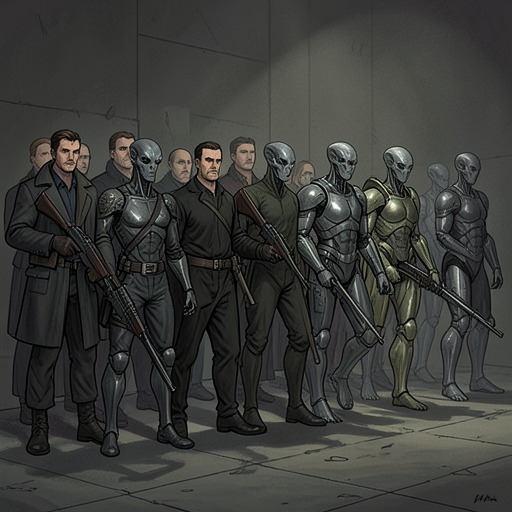
Tinea and Leah: [Cyberpunk, Alien Incursions, Murder and Mayhem, Girl's Love (WLW)]The Facility is the former kidnapping site that Tinea and Leah reclaim as a provisional home and strategic base. What begins as a place associated with captivity is gradually made useful through occupation, repair, experimentation, and deception. By the time Tinea and Leah prepare to leave, The Facility is no longer merely enemy territory: it has become a controlled environment whose rooms, supplies, infrastructure, and biological possibilities can be turned against the Antithesis.
From Captivity to Shelter
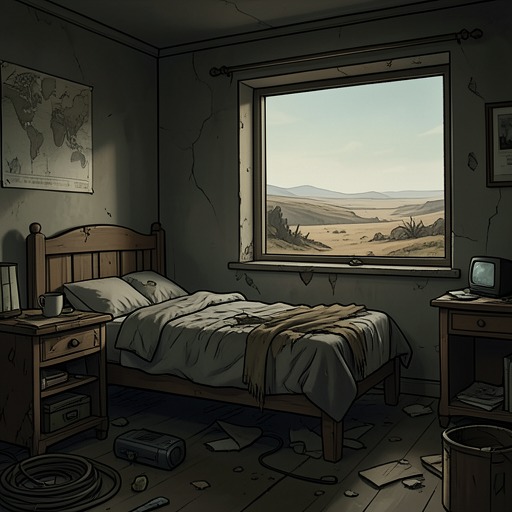
The Facility’s decisive transformation is psychological as well as tactical. Tinea recognizes that she and Leah have not spent much time there, and that it was originally the place to which they were kidnapped, yet the site begins to feel like shelter once they take control of it and use it as a base. The shift is not produced by comfort alone. It comes from possession and repeated practical use: the captives now inspect the grounds, decide what the building is for, and determine which threats may enter it. A location imposed on them by enemies becomes a place they can interpret and manage on their own terms.
That reclaimed status is reinforced when Tinea and Leah return after an excursion. Tinea circles The Facility to check whether anything has changed, finding only extensive mud, while a heavy storm front gathers on the horizon. The building remains exposed to weather and uncertainty, but the inspection establishes a routine of guardianship. They enter after checking the surroundings, treating the site not as a prison to escape immediately but as a base whose condition matters.
Infrastructure Under Pressure
The Facility is never a perfectly secure refuge. During the storm, Tinea discovers that the uplink has lost its satellite connection even though its diagnostics report no physical damage. The failure turns a normally transparent tool into an obstacle: the map cannot be checked remotely, and Tinea must go outside to investigate. Wind, rain, mud, and poor visibility make the exterior dangerous because the Antithesis remain active in such weather. The building therefore provides shelter without abolishing exposure; its safety depends on functioning systems and on the occupants’ willingness to leave its protection when those systems fail.
The site also lacks basic conveniences. When Tinea and Leah consider where to wash, the torn doorway leads into darkness, strong wind, and rain, while the facilities contain no designated washing area. These absences make The Facility materially unfinished, despite its usefulness as a base. Tinea must negotiate the consequences of her transformed body and the muddy environment without assuming that the building has been designed for either ordinary domestic life or her new needs.
The Facility’s technological resources are correspondingly repurposable rather than complete. The uplink, equipment, weapons, and catalogs support planning, but they do not guarantee control. Tinea’s access to manufacturing materials includes powdered ferrite, carbon dust, oxygen, water, napalm, concrete, and copper powder. Such stores make the site a possible workshop capable of producing threads ranging from iron and steel to graphene, as well as other useful materials. The building thus functions as a material assemblage: its value arises from the interaction of stored substances, fabrication technology, biological knowledge, and the decisions of its occupants.
The Facility as Trap
Leah proposes turning The Facility itself into an Antithesis trap. The plan is to poison jars in the pantry with a substance that will kill Antithesis feeding from them, then arrange the evidence so that the aliens appear to have discovered a miraculous poison in their own food slurry. The intended result is larger than a single kill. If the Antithesis interpret the deaths as a property of the jars or their contents, they may avoid nesting near the site altogether.
The deception depends on a convincing origin story. The poison must leave traces that suggest a contaminant produced it, allowing observers to infer that the Antithesis somehow brought their own destruction into the area and that the slurry activated the lethal agent. Tynea identifies Pulvinophages, a highly specialized Class I Moonsinger design derived from altered Antithesis cells, as a particularly credible choice. A vial of inert phages costs only five points, although it cannot reproduce; the specialized catalog itself costs twenty-five points because its usefulness is narrowly concentrated in this kind of application.
This strategy makes The Facility a narrative and ecological decoy. It is not defended only by force. Its pantry, food containers, biological traces, and apparent history are arranged to manipulate Antithesis behavior. The occupants seek to make the site seem dangerous in a way that the enemy can discover independently, converting the building from a target into a warning. The most effective defense is therefore not necessarily a stronger wall, but an altered interpretation of what the place contains.
The Nest and the Decision to Leave
The surrounding environment raises the stakes of remaining at The Facility. Tynea cannot send ordinary drones into the suspected underground Antithesis nest because they would be too noticeable, but she observes biomass entering and Antithesis units leaving. She is highly confident that the nest exists and remains young. Its youth does not make it harmless: because the swamp contains abundant biomass despite its toxicity, the nest may already have produced the Fourteens and may possess unusually strong defenders.
That possibility changes the practical meaning of the base. Tinea and Leah could earn several thousand more points in the area, and mobile nests may be nearby, but they lack the equipment and points required to confront the nest’s likely defenders safely. Leah therefore favors preparing The Facility and departing rather than wasting more time on an assault. The base is useful precisely because it permits a fast, controlled operation, not because it promises permanent security.
Their choice reflects a deliberate distinction between exploiting a location and becoming attached to it strategically. The Facility offers shelter, supplies, intelligence, and a trap, but the underground nest makes continued occupation increasingly costly. The building can be prepared for departure without surrendering its usefulness: its remaining contents may still draw the Antithesis in, while unwanted organic material can be bleached and the rest of the trash left behind for the aliens to sort through.
Domestic Routine and Deliberate Abandonment
Even while The Facility remains a battlefield position, Tinea and Leah develop routines that give it domestic character. After returning from a major operation, they consider sleeping there for one more night and leaving early the next morning. The decision is practical, but the wording of the plan reveals that the building has become a temporary household as well as a military site. Tinea asks Tynea, Ypsilon, and Leah to help create an evening to-do list, beginning with resupply. Work inside the base is organized collectively, through shared planning rather than the command structure of the kidnappers.
The final preparation reverses the usual logic of evacuation. They do not clean The Facility completely. Instead, they intend to make their departure obvious so that the Antithesis will not become suspicious of concealed leftovers and may even be drawn toward the site. Organic materials they do not want the enemy to obtain will be bleached, while other refuse is deliberately abandoned. Leaving becomes another form of control: the occupants shape not only what The Facility was while they lived there, but also what the Antithesis will believe about it afterward.
The Facility therefore ends its major phase in the story as a place intentionally emptied yet still active in its consequences. It has housed recovery, equipment management, technical improvisation, and intimate routine; it has also been converted into a biological lure and a source of misleading evidence. Its importance lies in this unstable duality. The building is home because Tinea and Leah make it one, a weapon because they redesign its material conditions, and a trap because they determine how its abandoned remains will be read by the enemy.